LLM API Authority Validation: Pin Every Request to Its Intended Origin

LLM API authority validation binds each request to the intended scheme, host, port, TLS identity, route, tenant, and approved model destination. This guide applies RFC 9110 origin, Host, :authority, misdirection, and 421 semantics to gateways and provider adapters, then defines normalization rules, deny behavior, DNS and connection-reuse tests, and evidence for every routed decision.
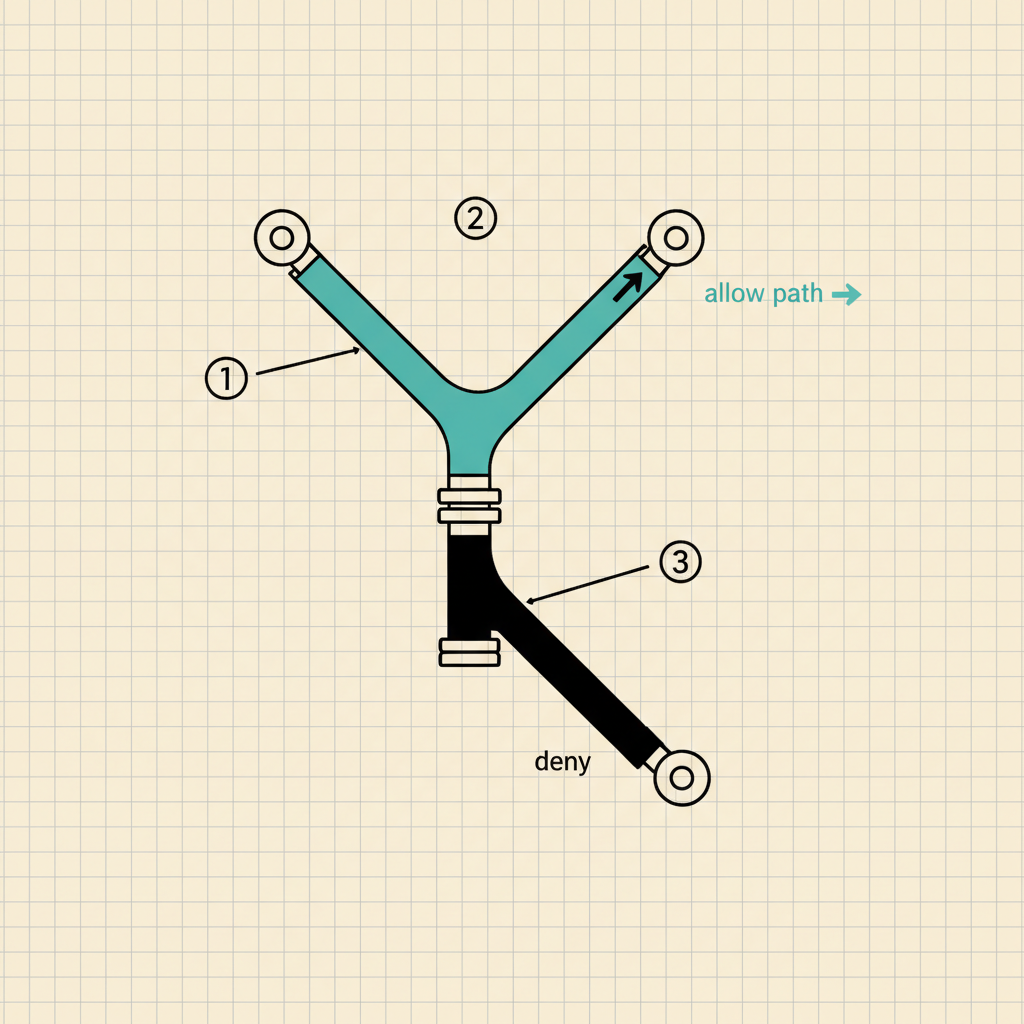
An LLM gateway can authenticate a caller and still send the request to the wrong authority. The destination decision begins with a scheme and an authority made up of the host and port. It continues through DNS, TLS certificate validation, HTTP Host or :authority, route selection, and the provider adapter that chooses a model endpoint. Every value must resolve to one approved origin before sensitive prompt content leaves the enterprise boundary.
Picture a packet trace beside the route manifest. The TLS server name says models.eu.example while the HTTP/2 :authority says models.us.example. The policy record names only "approved provider." That request needs a stop state, not a guess.
TL;DR
- Normalize and validate the scheme and authority, including its host and port, against an approved origin before forwarding prompt content.
- Bind DNS resolution, TLS identity, Host or :authority, provider account, region, and model route into one destination decision.
- Reject conflicting or unknown authority values and test connection reuse, redirects, alternate services, proxies, and DNS changes.
- Record the requested origin, resolved destination, route policy, connection context, decision, and correlation ID without logging credentials or raw prompts.
Origin combines a scheme with host and port
RFC 9110 Section 4.3.1 defines an origin as the normalized combination of a scheme and an authority made up of the host and port. Scheme and host are lowercased, the port loses leading zeros, and an omitted port becomes the scheme's default. Two origins are distinct when any member differs.
That definition gives an LLM route policy a concrete key. https://api.example.com:443 and https://api.example.com:8443 belong to different origins. So do HTTP and HTTPS on the same host. A friendly provider name or model alias lacks enough precision for a destination authorization decision.
Store approved origins in a versioned route manifest. Include the provider account or project, region, API family, and accepted path prefixes beside the origin. The origin establishes the network namespace. The route policy narrows which resources inside that namespace the caller may use.
The AI egress control implementation guide covers destination policy at the broader data-flow layer. Authority validation is the HTTP mechanism that proves the request is heading toward the origin named by that policy.
Normalize once using a standards-conforming URI parser. Reject userinfo in HTTP or HTTPS URLs. Handle internationalized domain names through one documented conversion path. Treat trailing dots, IPv6 literals, default ports, and percent-encoding consistently. Compare structured values rather than suffix strings. A rule that accepts every host ending in example.com can also accept an unintended sibling service.
Host and :authority drive application routing
RFC 9110 Section 7.2 explains that HTTP/1.1 uses the Host field, while HTTP/2 and HTTP/3 can use the :authority pseudo-header. The value carries host and port information from the target URI so a server can distinguish resources for several hostnames.
The same section calls host and port an application-level routing mechanism and identifies them as frequent targets for cache poisoning or redirection to an unintended server. An interception proxy is especially exposed when it trusts those values for internal routing or cache keys without validating the intercepted connection's target.
For an LLM gateway, accept destination input through one controlled route configuration. Caller-supplied absolute URLs, forwarded host fields, model base URLs, and adapter overrides must converge on the same approved origin. Define precedence and reject conflicts. Avoid silently choosing one of two disagreeing values.
Strip untrusted forwarding headers at ingress and add trusted equivalents according to the deployment topology. A service mesh or reverse proxy, including a load balancer, may rewrite connection details. Name the trusted hops and fields explicitly. The gateway should derive its destination decision from validated configuration plus trusted connection context, rather than from any header a public client can set.
My blunt view is that "the hostname looked familiar" has no place in an egress policy. Exact authority matching costs little and removes an entire class of routing ambiguity.
HTTPS authority requires certificate validation
RFC 9110 Section 4.3.3 associates HTTPS authority with the server's ability to use the private key corresponding to a certificate the client trusts for the identified origin. In HTTP/2 and HTTP/3, one secured connection can carry requests for several origins under defined authority conditions.
Validate the certificate for the intended host and send the correct TLS server name. Apply the organization's trust policy. Keep certificate validation tied to the normalized origin before reusing a pooled connection. A certificate covering several names gives cryptographic eligibility. It gives no business authorization to send a prompt to every covered name.
Connection coalescing deserves a production test. Two provider hosts may resolve to the same IP and appear on one certificate. The client library may reuse one HTTP/2 connection. Each request still carries its own authority and must pass route policy for that origin. Log the requested origin and connection identifier so a reviewer can see reuse without confusing it with destination approval.
Misdirected requests need a closed response
RFC 9110 Section 7.4 tells a server to decide whether its connection context is appropriate for the target URI. It describes mismatches between received host information and the connection's host or port as possible attempts to bypass filters or reach private content, including by poisoning a cache. An HTTPS request must arrive over a secured connection with a certificate valid for the target origin unless the connection comes through an appropriately trusted gateway arrangement.
RFC 9110 Section 15.5.20 defines 421 Misdirected Request for a server unwilling or unable to produce an authoritative response for the target URI. An origin server or a gateway acting on its behalf can use 421 when the target origin conflicts with configuration or connection context. The specification bars a proxy from generating 421, so component role matters.
An outbound LLM policy gateway often needs its own typed deny response when destination validation fails. Use the HTTP status that matches the component's role and documented contract. Preserve an internal reason such as authority_mismatch, origin_unapproved, tls_identity_failed, or redirect_origin_denied. Avoid forwarding prompt content while attempting to discover which destination the caller intended.
The OWASP API Security Top 10 for LLM endpoints places secure configuration and inventory beside route authorization. A typed denial can expose a stable occurrence identifier without leaking internal DNS or certificate data.
Redirects and alternate services reopen the decision
A redirect changes the target URI and can change origin. Re-run authority policy before following it. Strip credentials according to their protection space and apply the redirect limit. Reject a destination absent from the approved manifest. Record the original origin, redirect status, proposed origin, and decision.
Alternate services and provider failover also need approval. RFC 9110 recognizes that an origin can identify other authoritative services, but technical authority and enterprise policy remain separate decisions. A provider may offer another region that can serve the API while the enterprise restricts prompts to one jurisdiction. The route policy should win.
DNS rebinding and time-of-check differences deserve attention. Resolve through approved DNS and validate each connection destination. Constrain redirects. If policy uses address ranges, repeat the address check after resolution and before connection. Keep DNS answers and their observation times in protected diagnostic evidence. Avoid pinning addresses indefinitely because provider infrastructure changes.
The platform engineer AI risk checklist treats a changed provider endpoint or route, including a fallback, as a material release event. Add authority fixtures to that gate.
Tenant and model authority sit above the origin
A permitted origin says the gateway may connect to that namespace. The caller still needs authority for the API route, provider account, tenant, model, region, and data class. Bind those fields into the same decision record.
For a multi-tenant gateway, derive tenant routing from verified identity and server-side configuration. A caller-supplied tenant ID can be an input to validation, but it should never select credentials or a provider account by itself. Compare the requested tenant with the authenticated principal's tenant and reject disagreement.
Model aliases need deterministic resolution. Record the alias submitted and the resolved provider model identifier together with the route manifest version. If the alias can move between origins or regions, a change to that mapping reopens destination approval. The identity-aware proxy for LLMs explains the per-request identity and policy context surrounding this destination decision.
The acceptance fixture must exercise the deployed network
Run authority tests through the production load balancer, service mesh, DNS path, TLS client, connection pool, and provider adapter. A unit test against string comparison covers only the first step.
Include these cases:
- Uppercase host and an omitted default port normalize to the approved origin.
- A non-default port produces a distinct origin and denial unless explicitly approved.
- Host or :authority conflicts with the configured target.
- TLS server name and certificate identity conflict with the requested origin.
- Two origins share an IP and certificate under HTTP/2 connection reuse.
- A redirect remains on the approved origin, followed by one that changes origin; a provider fallback proposes a region absent from the manifest.
- Public DNS and private DNS return different address classes for the approved name.
- A caller supplies forwarding headers, tenant ID, base URL, or provider credential overrides.
- A server acting for an origin returns 421 and the client retries on a fresh connection according to its contract.
For every case, retain the normalized target, DNS result, TLS identity result, HTTP authority, route and tenant decision, connection ID, final destination, and response. Redact credentials and prompt content. The release fails when any layer guesses through a mismatch or forwards content before validation completes.
DeepInspect
DeepInspect can enforce approved destination and policy decisions for authenticated user or agent requests deliberately routed through its HTTP path to an LLM endpoint. At that boundary, it can evaluate supplied identity context, route, model destination, data classification, and policy, then preserve a per-decision record for the resulting allow or deny action, with redaction when policy requires it.
DNS administration, certificate issuance, private-endpoint configuration, and provider account setup retain separate owners. DeepInspect's evidence covers traffic that actually traverses the routed HTTP path. Direct provider calls and local model runtimes, along with STDIO tools, need controls at their own boundaries. Use the authority acceptance fixture to prove that the deployed route matches the approved origin manifest.
Book a demo today.