AI governance as a service, run with you.
We assess the AI your company uses, write the policy, enforce it on live traffic, and keep the evidence ready.
The risks
Any organization that uses AI in a meaningful way, inside the company or in a product it ships, carries four risks.
Sensitive data leakage
Customer, employee, and company data enters prompts, tools, and model APIs.
Agent tool attacks
An agent is manipulated into misusing the tools and data it can reach.
MCP tool attacks
An MCP server or tool is abused to reach data and actions it should not.
Non-compliance with AI regulations
AI-specific and sector rules call for evidence that controls are in place.
How the engagement runs
Assess
Inventory
A structured assessment of AI use across the company: sanctioned tools, unsanctioned tools, custom agents, and MCP integrations, and the data each one touches. It ends with a written current-state report and a remediation plan with sequencing and owners.
You receive an AI inventory, a data exposure map, a risk register, a directional framework gap view, and the remediation plan.
Remediate
Policy and enforcement
We write policies for your regulated data and business rules. Legal, Security, and the business owner review each one before it is enforced on the DeepInspect gateway. Each application and agent moves behind the gateway on its own release cycle.
You receive a signed-off policy set, and the gateway enforcing it on every application and agent you have routed through it.
Operate
Evidence
A governance team triages gateway alerts, tunes policy as AI use changes, reviews new agents before they receive production scope, and attributes token cost to users or groups.
You receive an evidence pack on request, a security review of each new agent, and a quarterly posture review with your security, compliance, and finance leaders.
Who does what
Our team
- -Runs the assessment and writes the report
- -Drafts the policies and deploys the DeepInspect gateway
- -Triages alerts and tunes policy
- -Reviews new agents before they go to production
- -Prepares the evidence pack and the quarterly review
Your team
- -Approves each policy before it is enforced
- -Sets the release schedule for moving applications behind the gateway
- -Names the executive accountable for AI risk
- -Takes part in the quarterly review
Sample output
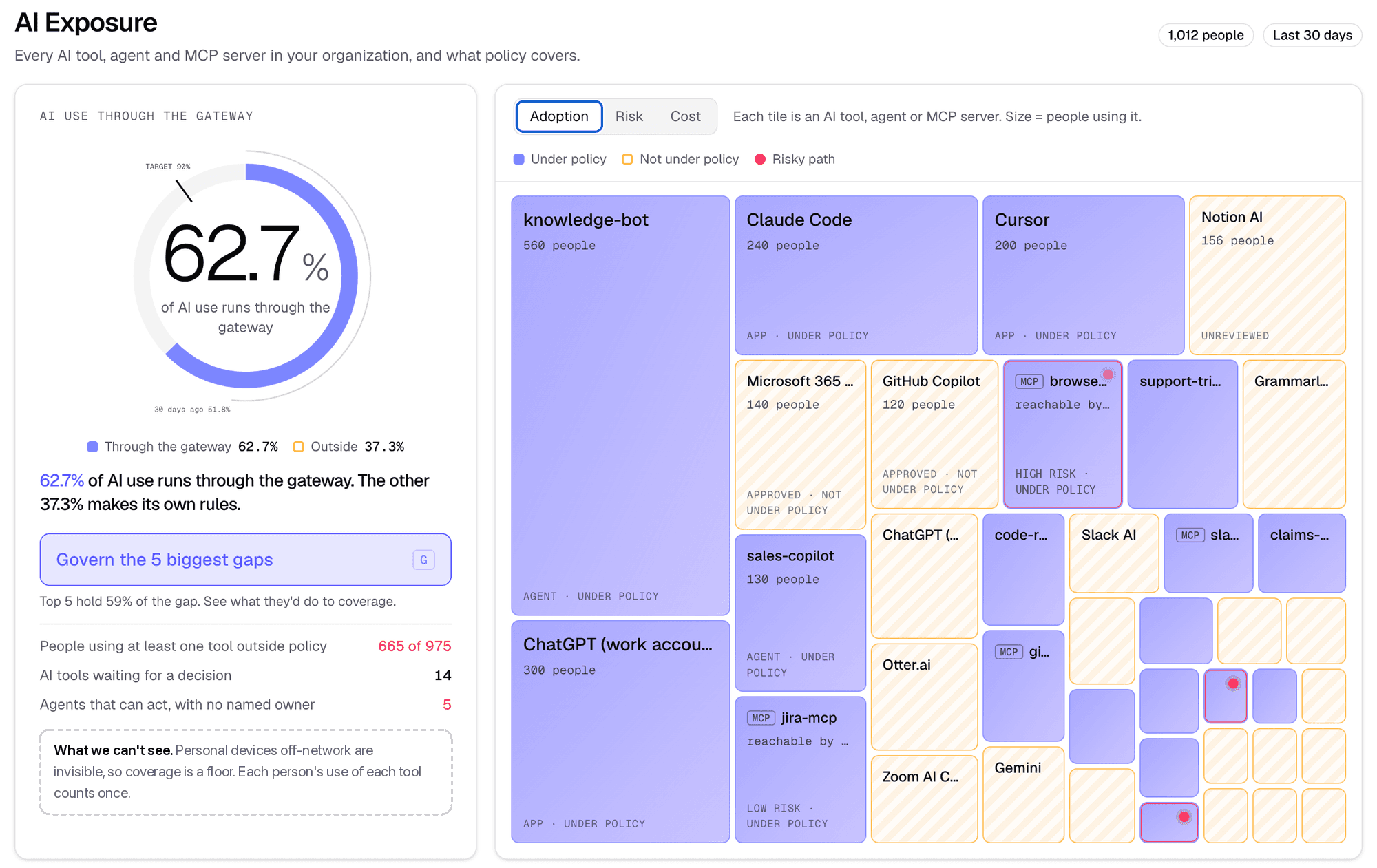
Two illustrations of what the work produces: an exposure view of AI use and what policy covers, and an excerpt from a risk register. Each finding leads to a written policy, and each policy produces audit records.
Risk register excerpt
Illustrative. Not client data.
| Application or agent | Path | Primary users | Severity | Observation |
|---|---|---|---|---|
| Custom pricing agent | API to an external model | Engineering | Critical | Over-permissioned access to an internal inventory database |
| Consumer chat tool | Web | Marketing, HR | High | Customer data and policy documents pasted into prompts |
| Unvetted support plugin | SaaS plugin | Customer support | High | Third-party plugin sends ticket payloads to an unknown endpoint |
| Developer AI access | Direct API | Engineering | Medium | No per-user attribution of token spend |
Who it is for
Any organization using AI in a meaningful way, inside the company or in products it ships to customers. Customers, auditors, and regulators ask which AI you use, what data it touches, and how you control it. The assessment, the policy, and the audit records answer those questions.
Organizations in regulated industries, such as banking, insurance, and healthcare, often start here because those questions arrive with evidence requests. The usual sponsors are a CISO, CTO, Head of Security, or Head of Compliance.
Questions
What is AI Governance as a Service?
A managed program in three phases. Assess inventories AI use and produces a remediation plan. Remediate writes policy and enforces it on the DeepInspect gateway. Operate has a governance team run the program with you.
What does the first discovery produce?
A high-level view of your AI usage, agent footprint, and headline gaps. It is complimentary, and you decide afterward whether to continue.
Do we have to install anything to start?
No. The assessment requires nothing to be installed. The gateway is installed in Remediate, after you have the findings and the plan.
What does the gateway see?
HTTP traffic that passes through it, including MCP tool calls over HTTP. Local shell and file access, MCP over STDIO, and traffic that bypasses the gateway are outside its enforcement.
Does the service replace an audit or provide a certification?
DeepInspect issues no certifications or attestations. Framework mapping is a directional gap view. The audit records support your own audits and your customers' security reviews.
Can we use the gateway on its own?
The DeepInspect gateway is the product behind the service. The product page describes what it does by itself. See the product.
Talk to us about your AI footprint.
You get a high-level view of AI usage, agent footprint, and headline gaps, and you decide afterward whether to continue.