OpenAI MCP Require Approval Policy for Sensitive Tool Calls

OpenAI MCP tools default to require_approval set to always, and the Responses schema also supports never or a tool filter. Teams should classify tools by data disclosure and action impact before creating exceptions. This guide defines a route-level approval policy, safe exception review, human decision context, and evidence for the routed OpenAI exchange.
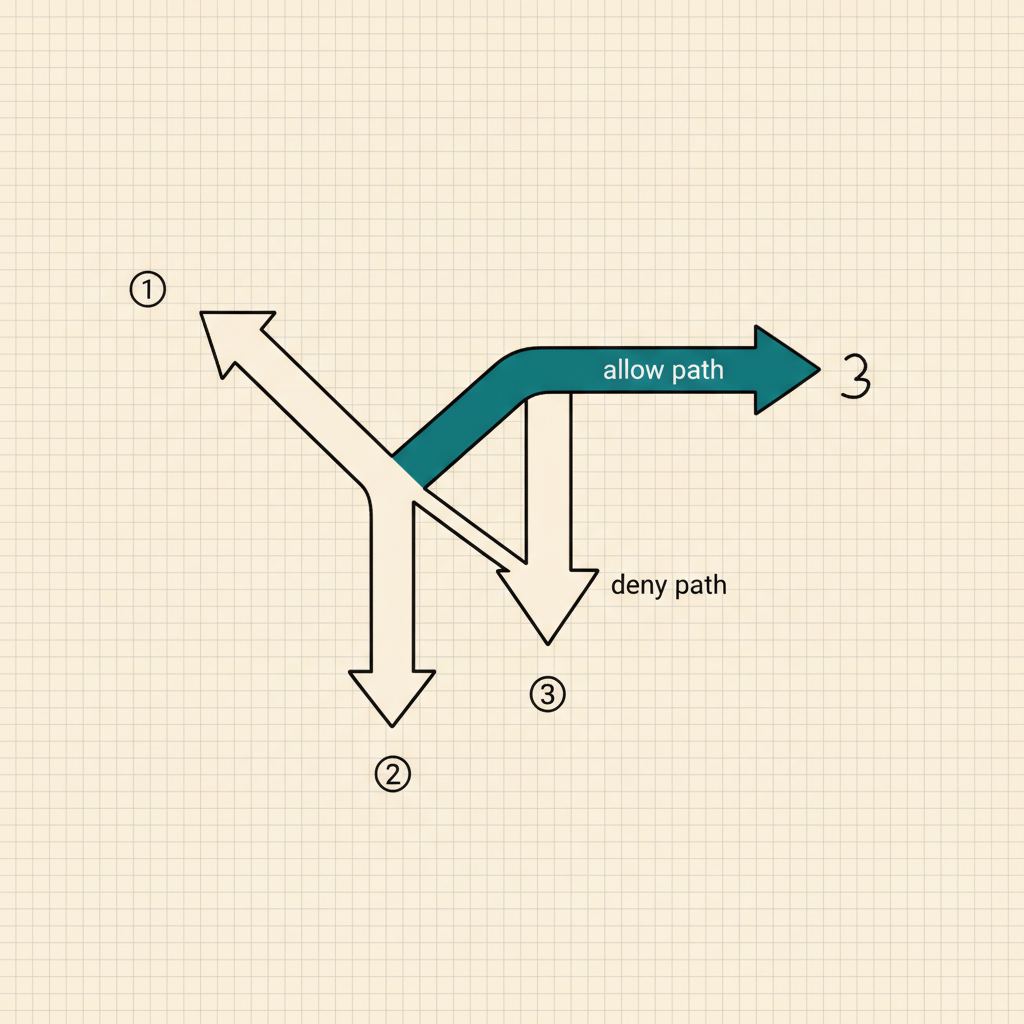
OpenAI's current Responses schema gives MCP tools a require_approval default of always. A developer can switch every tool to never or use filters to create narrower exceptions. That one field decides whether data can leave for a remote MCP call before a person or application approval step occurs. I want the default preserved until each exception has a named owner and a bounded tool set. The exception also needs a clear account of the data or action involved.
TL;DR
- Preserve OpenAI's documented
alwaysdefault for unclassified MCP tools and sensitive routes. - Create
neverexceptions only for named tools with bounded data, effects, identities, and destinations. - Evaluate disclosure risk for reads and action impact for writes before assigning an approval class.
- Record the effective approval policy beside each routed Responses request and each approval outcome.
The field controls a provider approval checkpoint
The Responses create reference documents require_approval with always and never as literal choices. It also accepts a filter object, with always as the default. The filter can associate tool names or a read_only condition with the always and never branches. Those values control OpenAI's MCP approval flow for that tool definition.
OpenAI's MCP approval guide says the default asks for approval before data is shared with a connector or remote MCP server. When approval is required, the Response contains an mcp_approval_request. The follow-up request carries an mcp_approval_response with the request ID and an approve boolean.
The provider mechanism leaves your application to decide who can approve and what context they see. Your application also decides how long the decision remains valid and which tools qualify for an exception. The remote MCP server retains responsibility for its own authorization and execution.
The OpenAI API gateway pattern is a useful place to enforce the request-side policy before the provider sees it.
Classify disclosure and action separately
A practical policy review starts with two questions. What data can this call disclose to the MCP server? What effect can the tool produce in the connected service? Give each tool both classifications because a read can expose protected data and a write can carry little sensitive input while causing a large business effect.
A CRM search may be read-only yet return customer contact details. A calendar status lookup can expose executive availability. A ticket-label update mutates data but may have a smaller consequence than sending an email or deleting a record. Issuing a refund or changing a permission can have a larger consequence. Tool names alone rarely capture those differences, so the policy owner should review the current input schema and expected output class.
Assign always to tools with protected inputs, broad queries, external communication, financial effects, deletion, permission changes, or uncertain behavior. Consider a never exception only when the route, caller role, server, arguments, and output class keep the operation inside a reviewed envelope.
Per-route AI policy prevents a low-risk exception on one workflow from becoming a global bypass.
Exceptions should be exact and reversible
The most dangerous configuration is global never on a server that can add or change tools. A new tool can enter the model's available set without inheriting the review that justified the original exception. Prefer an object filter or a tool definition whose exception names are exact and versioned, then reconcile them against the imported catalog.
Keep the exception list short enough for a reviewer to understand in one screen. Record the owner, review date, allowed roles, expected data classes, server label, tool-name set, and rollback condition. If a tool schema or server operator changes, move the tool back to always until review finishes. A catalog digest helps automation detect the change, while a human owns the risk decision.
OpenAI's safety section recommends using require_approval with allowed_tools so sensitive actions enter an approval flow. Configure the two fields deliberately: the allowlist limits which tools the model can see, while approval policy chooses the checkpoint for a proposed call. An excluded tool needs no approval rule because it should remain unavailable.
A route configuration with six undocumented exceptions is a security debt register wearing JSON syntax.
Read-only metadata does not settle sensitivity
The schema can filter on read_only when the server annotates tools with readOnlyHint. That metadata can reduce policy maintenance for trusted catalogs, but read-only status describes mutation behavior. It says little about confidentiality and query breadth, including downstream disclosure.
OpenAI's MCP risks and safety guidance describes a web page steering a model to retrieve a customer's email address from a CRM and place it in a URL. The CRM tool can be read-only throughout that sequence. Sensitive data still leaves its expected context.
Use read-only as one signal. Add server trust and data classification before creating a no-approval branch. Also account for the user role and route purpose. Apply destination constraints as well. For a tool whose output can contain PHI or source code, the safer baseline remains always unless another deterministic control prevents the disclosure at the routed model boundary. The same baseline applies to credentials or customer records.
The approver needs a concrete decision
An approval card should identify the MCP server and tool. It should show the target and consequential arguments, along with the data expected to be shared. Show the authenticated account or tenant affected by the call. Hide secret values and escape untrusted strings. The button labels should say what happens, such as "Send invoice" or "Deny," instead of a context-free "Continue."
Approval fatigue is a policy failure. If users receive ten nearly identical prompts during one task, they will stop reading. Reduce that pressure by narrowing allowed_tools and improving route design. Create reviewed exceptions for genuinely low-risk calls. Avoid broad session approval for a category whose arguments or targets can change materially.
The application should bind the decision to one approval-request ID and one originating Response ID. It should also bind one authenticated approver and one digest of the displayed call. AI agent observability can join the model step and human decision without pretending the approval authorizes every later action.
Audit the effective policy and the outcome
Record the policy as OpenAI received it, not only the configuration template it came from. Record the route and authenticated identity context. Include the server label and tool names. Capture the effective require_approval shape and allowed_tools shape. Preserve the policy version and catalog digest. Keep the Response ID beside the approval-request ID, then record the decision outcome.
Distinguish a granted prompt from a denied one. Give reviewed exceptions their own outcome, and record policy-unavailable calls separately. Those states answer different audit questions. A simple boolean called approved loses the difference between a denied prompt and a call that never asked.
Start the policy tests with an unclassified tool and a named exception. Add a read-only case that returns sensitive data, then change its schema and name. Cover multiple approval requests and a changed user. Cover a stale decision too. Confirm that absence of require_approval produces the documented provider default and that your adapter never inserts global never as a convenience default.
DeepInspect
DeepInspect can enforce require_approval policy on authenticated user or agent Responses requests deliberately routed through its HTTP proxy to OpenAI. A route can preserve always and permit exact reviewed exceptions. It can reject global never when the server or data class requires a checkpoint. Each decision can retain the normalized request field and policy version.
The application owns the approval interface and approver authentication. It also owns consent wording and decision lifetime, along with replay handling. The MCP server owns authorization and execution. DeepInspect covers the routed OpenAI model exchange where the approval configuration and resulting approval item appear.
Book a demo today.
Frequently asked questions
- Does require_approval replace tool authorization?
No. It controls the OpenAI approval checkpoint for a proposed MCP call. The MCP server still needs to authorize the caller. It and the connected service also need to authorize the tool and arguments. A user's approval expresses consent in the application workflow; it does not grant a new target-system entitlement.
- Should every read-only tool skip approval?
No. A read can disclose customer records or source code. It can also disclose calendar details or other protected data. Review confidentiality and query breadth alongside mutation behavior.
readOnlyHintis server-supplied metadata, rather than a complete sensitivity classification.- When is require_approval set to never reasonable?
Use it for an exact, reviewed tool set. Its route and caller must be tightly bounded. The same applies to its data and destination. Its effects must remain tightly bounded as well. Keep the exception versioned and reversible. Move it back to
alwayswhen the catalog, schema, server operator, or expected data class changes.- How should teams reduce approval fatigue?
Expose fewer tools and split broad workflows into narrow routes. Create documented exceptions for calls that remain low risk under deterministic controls. A single blanket approval hides changing arguments, while repeated prompts indicate the route policy needs redesign.