LLM Load Balancing Needs Policy-Aware Routing

LLM load balancing distributes eligible requests across deployments according to health, capacity, latency, and rate-limit state. The eligibility step comes first: identity, data classification, residency, and model authorization must remove forbidden destinations before an operational algorithm chooses among the remaining endpoints.
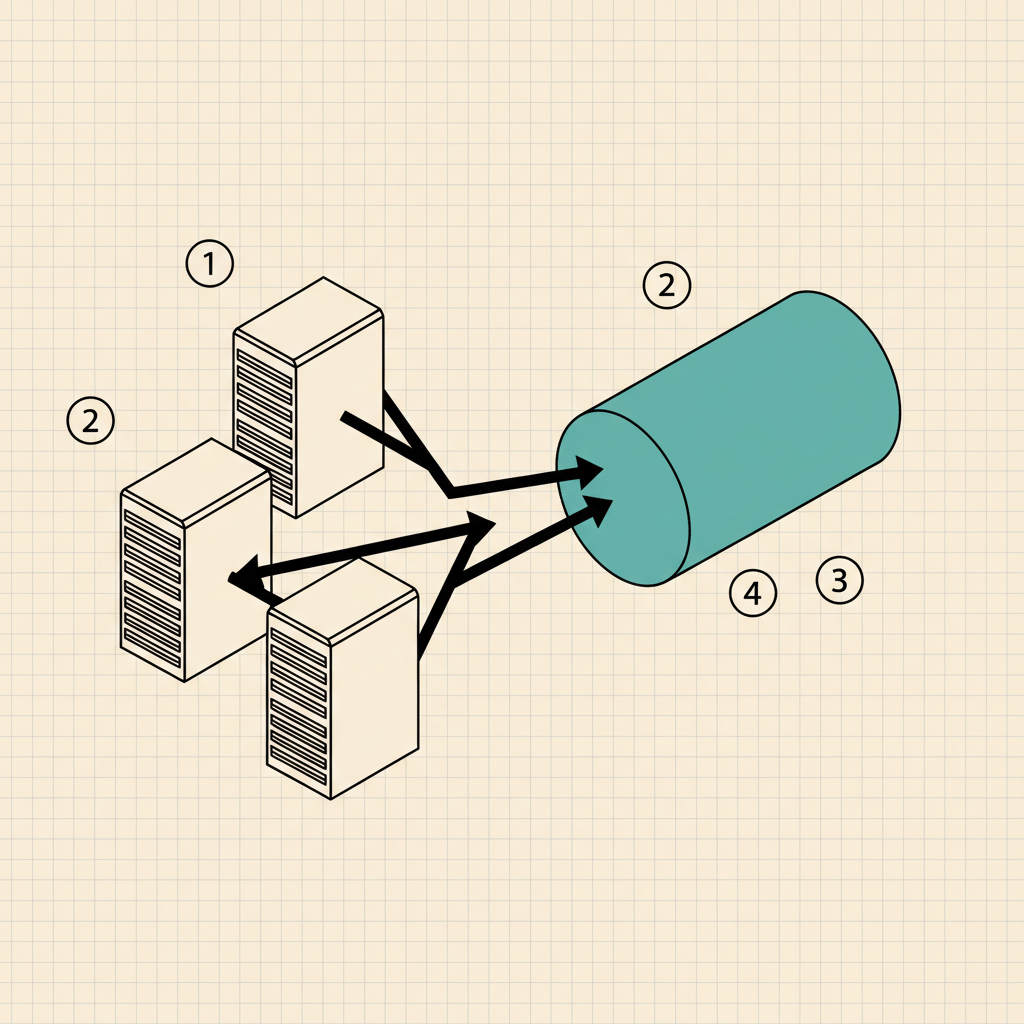
LLM load balancing chooses one deployment from a pool of equivalent or compatible endpoints for each inference request. Production routers watch health and active requests. They also track latency and provider limits, then send work to a destination that can serve it. That operational choice must happen after policy eligibility. A healthy endpoint in another geography or account may still be forbidden for the caller's data. The same restriction can apply to another model tier.
I want to separate load distribution from fallback. Model selection is a third routing function that teams often compress into the same rule. The distinction decides which endpoint list the balancing algorithm is allowed to see.
TL;DR
- Filter the endpoint pool by identity, data classification, residency, and model authorization before balancing traffic.
- Balance eligible requests using health, active load, latency, or rate-limit state. Each signal has a different failure mode.
- Preserve one root request ID and record every routing attempt, endpoint, policy version, and terminal outcome.
- Keep fallback semantics separate, especially after streaming begins or a tool call may have executed.
LLM load balancing starts with eligible deployments
A router usually receives a logical model name and maps it to several deployments. Those deployments may sit in different regions, accounts, providers, or clusters. The first operation should remove destinations that violate the request's authorization envelope. Only then should the router compare load.
Eligibility can depend on the authenticated role, prompt classification, tenant contract, approved provider list, geographic processing rule, and model capability. A request containing regulated records may have one approved regional deployment while a public documentation query can use the whole pool. Passing both requests to the same round-robin list turns an availability mechanism into a policy bypass.
This ordering extends the invariant described in multi-model routing: classify and authorize before selecting the upstream. Load balancing then operates on the permitted subset. The distinction is visible in an architecture review as two separate boxes, not one arrow labeled "smart routing." I have little patience for that label because it hides the decision we need to audit.
Balancing signals answer different questions
LiteLLM's official load-balancing documentation lists routing strategies based on active requests, usage, latency, and cost. Those are different measurements rather than interchangeable tuning options.
Least-busy routing estimates current concurrency and sends work toward a deployment with fewer active requests. It reacts quickly to uneven queues but needs timely shared state. Usage-aware routing tracks request or token consumption against provider limits. Latency-aware routing learns which destination responds fastest, though stale samples can keep traffic pointed at a deployment that has just degraded. Cost-aware routing can reduce spend only after policy and workload compatibility have narrowed the candidates.
Round robin remains defensible when deployments have similar capacity and request sizes. Weighted distribution fits unequal quotas or hardware. The ugly case is a mix of short classification prompts and long document summaries: request count looks balanced while one backend is buried under tokens. Measure queue depth and token throughput alongside ordinary request rate.
Health checks need workload context
A generic TCP or HTTP health check proves that a port accepts connections. It says little about an upstream model's ability to complete the workload. A useful readiness signal covers authentication and model availability. It should also cover queue pressure and a bounded inference probe. Provider rate-limit responses also belong in routing state because a technically healthy endpoint can be unavailable to one account for the next request window.
Circuit breakers stop repeated calls into a degraded destination. The AI gateway circuit-breaker pattern tracks failures over a defined window, opens the route when the threshold is crossed, and admits controlled probes before restoring traffic. Load balancing consumes that state by removing an open destination from its eligible pool.
Avoid a shared global health bit when failures depend on tenant credentials or model identifiers. Quotas can make the failure just as specific. One account may be rate-limited while another retains capacity. One model deployment may fail while a second model on the same provider remains healthy. The routing key should preserve the dimensions that caused the failure.
Regional distribution carries a policy decision
Amazon Bedrock's official cross-Region inference documentation distinguishes geographic profiles, which route within a named geography, from global profiles that can route across supported commercial regions. AWS explicitly ties that choice to compliance and data-residency requirements.
That is the eligibility rule in a first-party service. A global pool may offer more capacity, but a residency-bound workload should enter only the approved geographic profile. The load balancer never gets permission to expand the processing boundary merely because a nearby destination is throttled.
Multi-region deployments add state questions. Health and quota information can tolerate brief inconsistency. Authorization policy needs a defined version. Audit records need a durable write path that survives the same regional incident the router is handling. The multi-region failover architecture covers traffic promotion and regional evidence continuity; load balancing is the steady-state distribution mechanism inside that design.
Retries stop being safe after side effects
Load balancing handles an initial placement. Fallback handles what happens after that placement fails. Before output begins, a retry against another eligible deployment may be safe for a read-only inference request. Once streaming has delivered tokens, a second response can duplicate or contradict visible output. Tool calls create a harder boundary because the first attempt may have changed an external system before its connection failed.
The LLM fallback routing pattern uses a root request ID and per-attempt IDs. It also uses replay tokens for side-effecting calls. It also treats policy denial as terminal. A denial says the request lacks permission; sending it to another backend converts the router into an authorization bypass.
Record the distinction in telemetry. An initial placement and capacity spillover should remain distinct from a provider retry and policy rejection. They should not share one generic routed event. During an incident, an operator needs to see the white timeline marks for each attempt and the exact reason the endpoint changed.
DeepInspect
DeepInspect enforces the eligibility step at the HTTP AI request boundary. It evaluates the authenticated identity and prompt classification against the route and active policy before traffic reaches an upstream LLM. The balancing layer can then choose among endpoints permitted by that decision.
Every decision produces an audit record tied to the request and policy version. DeepInspect does not need to replace the operational router.
Book a technical deep dive at deepinspect.ai.
Frequently asked questions
- Which load-balancing strategy fits LLM traffic?
Choose the signal that tracks the constrained resource. Active-request routing works for deployments with similar request sizes. Token or usage-aware routing fits provider quotas and workloads with large variation in prompt length. Latency-aware routing helps interactive workloads when samples are fresh and segmented by model and region. Weighted routing is useful for unequal capacity. Policy eligibility remains a prior step under every strategy.
- Should the router balance across different model families?
Balancing assumes that destinations can satisfy the same task and policy requirements. Different model families may vary in quality, context length, tool format, data terms, and regional availability. Treat that choice as model routing with explicit evaluation and authorization, then load-balance among compatible deployments. Hiding a model substitution inside an ordinary capacity rule makes output changes hard to explain and audit.
- What should an LLM routing record contain?
Record the authenticated caller or workload identity, root request ID, data classification, logical model, eligible pool, selected deployment, routing strategy, policy version, health state, attempt number, latency, and terminal outcome. For retries, link every attempt to the same root ID. For tool calls, preserve the replay or idempotency token that prevents duplicate execution.
- Can load balancing override data residency during an outage?
A capacity or availability event should never silently expand the permitted region set. Encode residency in endpoint eligibility and treat an empty eligible pool as a controlled failure. An approved emergency policy can change that boundary through a named version and authorized process, which then appears in the request record. The load-balancing algorithm still selects only within the pool it receives.