LLM API Authentication Challenges: A Correct 401 and 403 Contract

LLM API authentication challenges need a precise contract across 401, WWW-Authenticate, credential replacement, 403, proxy challenges, and machine-readable errors. This guide separates authentication from request-time authority, defines safe forwarding and logging behavior for an LLM gateway, and supplies negative tests for expired tokens, wrong audiences, multiple schemes, insufficient permissions, and stale credentials.
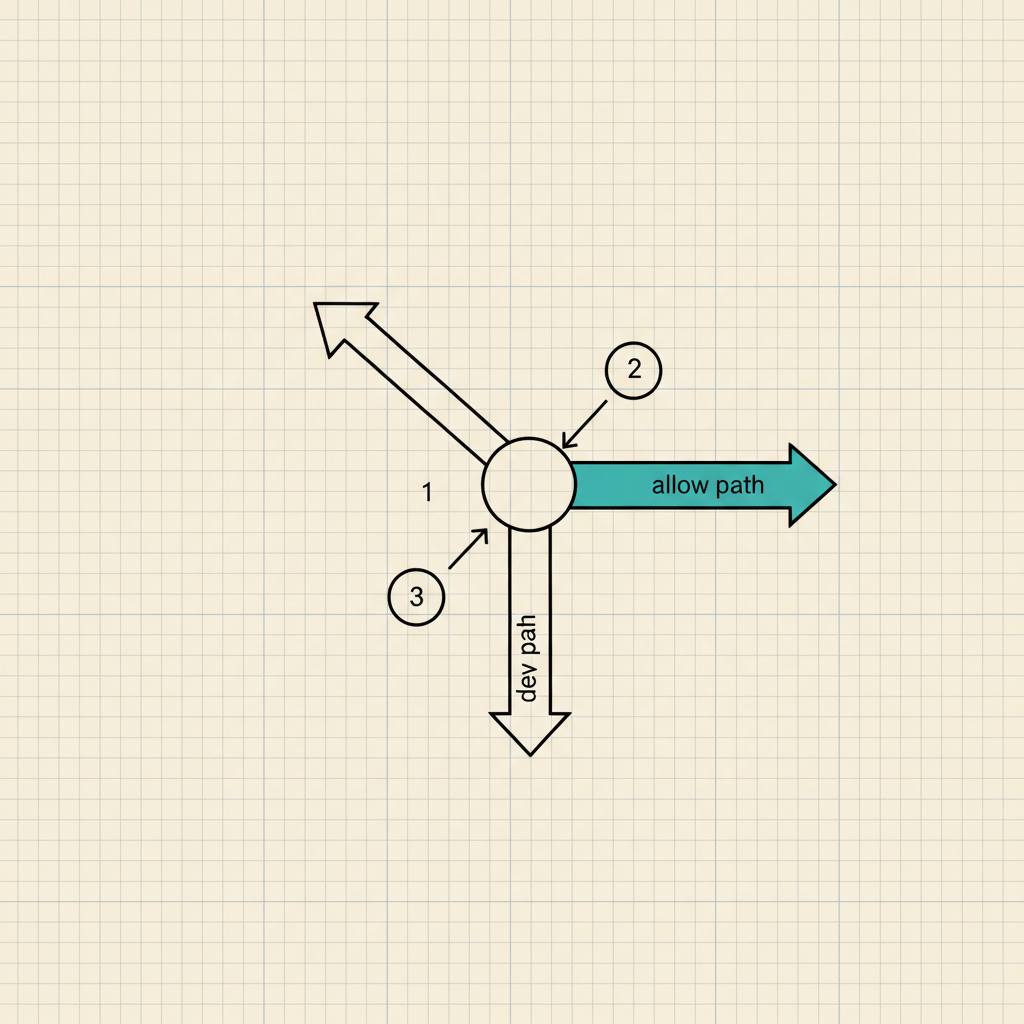
An LLM API authentication contract begins with a precise 401 response. The response identifies at least one authentication challenge for the target resource, while the client decides whether it can obtain or replace credentials. A 403 belongs later, after the server understands the request and refuses it. Blurring those states creates retry loops and weak telemetry. Authorization decisions disappear behind the label "auth error."
I want the negative test on screen: an expired token in the left terminal receives 401 plus a documented challenge, while a valid low-privilege token in the right terminal receives 403 for the same model route. The difference should survive every proxy hop.
TL;DR
- Return 401 with at least one WWW-Authenticate challenge when the target resource lacks valid authentication credentials.
- Use 403 when the server understands the request and refuses it, including cases where supplied credentials lack sufficient authority.
- Preserve upstream challenges across forwarding and prevent credentials from leaking across origins or protection spaces. Redact secrets from logs.
- Test expired, revoked, malformed, wrong-audience, and wrong-issuer credentials separately from valid identities with insufficient route authority.
A 401 response carries a challenge contract
RFC 9110 Section 15.5.2 defines 401 Unauthorized for a request that lacks valid authentication credentials for the target resource. The status name is historically awkward, but the semantics are direct. The server must send WWW-Authenticate with at least one challenge applicable to the resource.
RFC 9110 Section 11.6.1 defines that field as a list of authentication schemes and parameters. A response can carry more than one challenge, and the field can appear more than once. Client parsers must handle commas inside challenge parameter lists instead of splitting every comma as a new scheme.
For an LLM API, document the schemes supported by each route. A browser-facing application might receive a session-oriented challenge at its own boundary, while the model API accepts a bearer credential or a workload identity token. Avoid advertising a scheme the receiving service cannot actually verify. The route manifest should name issuer, audience, accepted algorithms, clock-skew tolerance, and required assurance or token class.
A proxy forwarding an upstream response must preserve WWW-Authenticate fields under RFC 9110. If a gateway terminates one authentication layer and creates its own downstream request, document the two protection spaces separately. The challenge exposed to the client should describe the client-facing resource, rather than leaking an upstream provider's private authentication contract.
Protection spaces prevent casual credential reuse
RFC 9110 Section 11.5 defines a protection space using the server origin and an optional realm. That scope determines where a client may automatically reuse credentials. A single protection space stays inside its server unless the authentication scheme explicitly permits broader scope.
This matters for multi-provider LLM clients. A credential accepted by models.example.com should stay bound to that origin and resource contract. Redirects, alternate base URLs, and regional endpoints can move a request toward another origin. The client must re-evaluate credential attachment at that boundary. Copying an Authorization field to a new host turns routing behavior into credential disclosure.
At an internal gateway, bind the incoming credential to the client-facing route. Resolve the caller identity through a trusted verifier, then create the provider-facing authentication according to the gateway's own credential policy. Never treat a caller-supplied identity header as equivalent to a verified token claim. The identity-aware AI gateway guide explains the identity propagation contract at the LLM request boundary.
Keep credentials out of logs and problem bodies. Record a token fingerprint or verifier event ID when correlation is needed. Store issuer, subject, audience, expiry, authentication method, and validation outcome only according to the organization's data policy. Raw bearer values and private keys belong in credential custody systems.
403 marks a different decision state
RFC 9110 Section 15.5.4 defines 403 Forbidden for a request the server understood and refuses to fulfill. Supplied credentials may be insufficient, and repeating the same request with the same credentials should stop. The reason can also be unrelated to credentials.
For LLM APIs, 403 can represent a valid caller blocked from a model or region, a role denied access to a sensitive route, a tenant barred from a capability, or an agent operating outside delegated authority. Keep those policy reasons as stable machine codes. The HTTP status gives generic software the class of outcome, while a typed error body gives the application a corrective action.
Authentication answers which principal presented valid credentials. Authorization decides what that principal may do with this model, route, data class, and request at this moment. The post-authentication gap guide covers the failure created by stopping after token validation.
My blunt view is that returning 401 for every policy denial trains clients to churn credentials against a decision no credential refresh can fix. It also erases a useful security distinction from the audit trail.
Some deployments hide the existence of a forbidden resource with 404, a behavior RFC 9110 permits. Make that an explicit resource-disclosure policy. Use it consistently, document the client behavior, and retain the actual internal policy outcome in protected evidence.
Problem details can carry corrective machine fields
RFC 9457 Section 3 defines application/problem+json for machine-readable HTTP error details. The core members include type, title, status, detail, and instance. Authentication and authorization problems can add extensions for stable, non-secret fields.
For 401, a problem type can identify invalid or expired credentials while WWW-Authenticate remains the protocol challenge. Useful extensions may include a public reason code and correlation ID. Avoid echoing token claims wholesale. For 403, include a policy reason such as model_not_allowed and region_denied, with delegation_insufficient when disclosure policy permits it.
The response body's status member is advisory under RFC 9457. Match it to the actual HTTP status. Keep title stable for the problem type and put occurrence-specific guidance in detail. Clients should branch on the type or a documented extension, rather than parsing the human sentence.
An instance identifier can connect the client response to a protected server event. Make the identifier opaque and authorization-protected if it can be dereferenced. The AI audit log chain-of-custody guide describes how to preserve the decision event after the response leaves the service.
Challenge forwarding needs a named owner at each hop
Map every HTTP hop in one sequence: caller to application and application to gateway. Then map the gateway to model endpoint hop. For each hop, name the credential issuer, verifier, audience, challenge owner, and policy decision point. A shared diagram label such as "auth" hides these separate contracts.
If the application authenticates the user and calls the gateway with a workload token, decide how the natural-person identity reaches policy evaluation. It might arrive as a trusted token exchange result or a signed application assertion validated by the gateway. The application owns accurate upstream identity. The gateway owns verification of the artifact it receives and the request-time policy applied to the routed model call.
Provider credentials authenticate the gateway or application to the model provider. They rarely prove which human initiated a request. Keep the provider account separate from the application workload. Record the natural person and any agent in their own identity fields. Delegated authority needs its own scope and expiry. The confused deputy AI checklist provides a release gate for that chain.
For proxy authentication, 407 and Proxy-Authenticate belong to the hop where a client authenticates to a proxy. Avoid translating every 407 into 401. The statuses identify different authenticating parties and support different client handling.
Negative tests should preserve each failure reason
Run the fixture through the production load balancer and gateway, then verify both the client response and server-side decision event. Include these cases:
- Missing credentials receive 401 and at least one valid challenge.
- A malformed credential receives the documented 401 problem type.
- Expired and revoked credentials produce distinct protected verifier reasons, while wrong issuer and wrong audience fail before route authorization.
- An unsupported scheme receives a usable challenge for an accepted scheme.
- Multiple challenges survive intermediary parsing and forwarding.
- A valid caller denied the model route receives 403.
- A valid route caller denied by data-class policy receives 403 with the approved disclosure level.
- A redirected request to another origin omits the original credential.
- Repeating the same 403 with the same credential ends without a retry loop.
Capture the HTTP status, challenge fields, problem type, verifier event, resolved principal, policy version, and final decision. Redact credential values from the fixture output. The release fails if an intermediary drops the challenge, rewrites the status, or changes 403 into a credential-refresh loop.
DeepInspect
DeepInspect can evaluate authenticated user or agent traffic deliberately routed through its HTTP path to an LLM endpoint. It uses the identity context supplied through the approved application contract alongside route, model, data classification, and policy, then records a per-decision allow or deny outcome, with redaction where required.
The upstream identity provider still owns user authentication, credential issuance, revocation, and challenge semantics at its resource boundary. Provider keys and workload credentials retain their own custodians. Direct provider calls and local runtimes outside the routed HTTP path remain outside DeepInspect's enforcement evidence. The same applies to STDIO traffic. Test the complete topology so a valid credential never becomes an assumption of unlimited request authority.
Book a demo today.